


Why Modern Marking Systems Matter
When your expiration date looks like it belongs in a history book, the system probably does too.
At Matthews Marking Systems, we believe marking should support production, not slow it down. That’s why we focus on helping manufacturers mark smarter and adapt faster as production demands change.
When Marking Falls Behind the Line
Outdated marking systems tend to show their age in subtle but costly ways:
- Code updates that require manual changes at each printer
- Inconsistent formats across lines or facilities
- Slower response to new SKUs, packaging changes, or regulations
- Increased risk of errors when operators rely on workarounds
As production evolves, these limitations become harder to ignore. What once worked at a smaller scale can quickly turn into friction when speed and flexibility matter most.
Mark Smarter with Any Connected Controller
Modern marking starts with simplifying control.
Instead of managing individual devices in isolation, today’s marking environments benefit from a more advanced approach where any connected controller can create, manage, and update messages across technologies and lines.
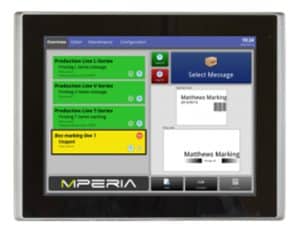
That is where the MPERIA® controller plays a key role. It provides a unified interface for managing codes, variable data, and formats across marking systems. This helps teams reduce manual intervention and maintain consistency across operations.
With smarter control, changes happen faster. Errors are easier to prevent. Marking becomes a coordinated part of production and not a bottleneck.

Adapt Faster as Production Changes
Adaptability is no longer a “nice to have.” Shorter runs, more SKUs, and evolving packaging formats demand marking systems that can adjust without disruption.
Different applications call for different technologies, and flexible marking strategies make room for that:
- V-Series systems support bold, durable codes in demanding production environments
- MPERIA® Laser solutions deliver permanent, high-precision marks on a wide range of materials
- Axian printers provide high-speed, non-contact coding for fast-moving production lines
- L-Series printers provide clean, high resolution coding for cartons and secondary packaging
- T-Series printers support vivid, high resolution carton and case coding
- A-Series systems enable automated pallet labeling to extend traceability beyond the package
When these technologies are connected through a common controller, teams can adapt marking methods without rethinking the entire process.
Building a Marking Strategy That Evolves
Smarter marking isn’t about replacing everything at once. It’s about building systems that can grow and adjust alongside production.
Modern marking strategies support:
- Faster changeovers with less manual effort
- Clear, consistent traceability across products and locations
- Expansion across lines or facilities without added complexity
At Matthews Marking Systems, marking solutions are designed with that flexibility in mind — helping manufacturers modernize at their own pace while staying ready for what comes next.
Back to the Cartoon: Clarity Is the Goal
The Roman-numeral expiration date gets a laugh, but it also makes a point. Marking should communicate clearly, instantly, and reliably to operators, inspectors, and anyone downstream.
When marking systems are easy to manage and quick to adapt, clarity becomes the standard, not the exception.
Mark Smarter. Adapt Faster.
Modern marking systems help production teams move quickly without sacrificing accuracy or consistency. With the right combination of centralized control and adaptable technologies, marking keeps pace with change, instead of holding it back.
If your marking system feels harder to manage as production evolves, it may be time to rethink what smarter marking looks like.