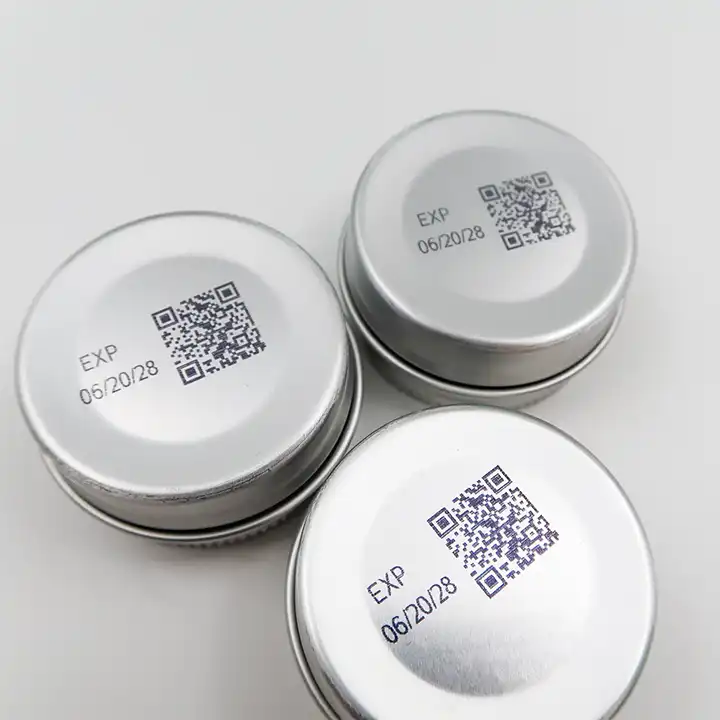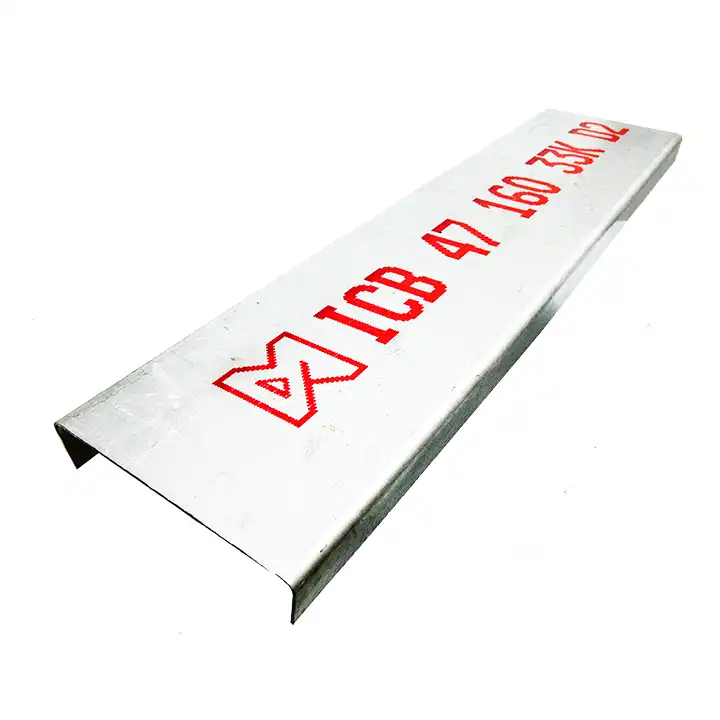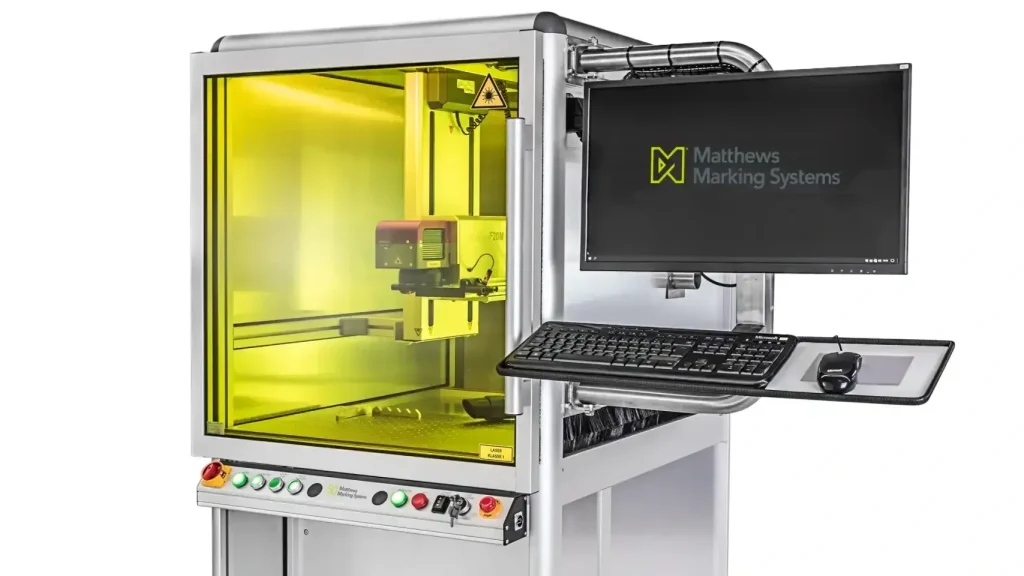
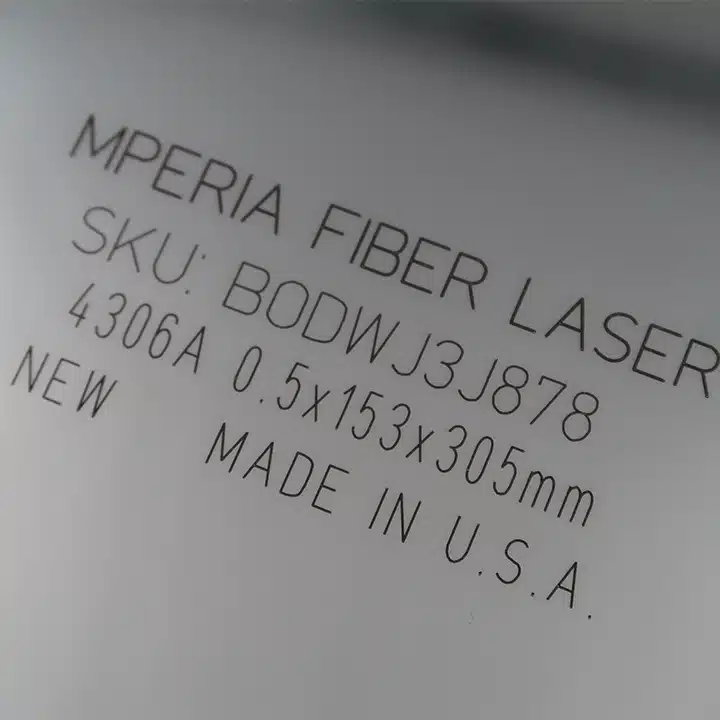
Permanent fiber laser marking on a steel plate with SKU, product information, and country of origin.

Metal Printing and Marking

Metal manufacturing facilities place incredible demands on marking systems. High temperatures, oily or dusty surfaces and variable material compositions make for a particularly challenging environment. Our lasers and printers are designed specifically for operation in harsh environments with minimal maintenance so you can maximize uptime and ROI.

Why Choose Matthews for Metal Marking?

Permanent Product Identification

Built to Last: Apply durable product information that remains readable throughout manufacturing, processing, and distribution

Improve Product Recognition: Mark part numbers, specifications, heat numbers, and customer information directly on metal products

Consistent Readability: Produce clear, high-contrast marks across a wide range of metal surfaces and finishes

End-to-End Traceability

Track Products Through Production: Print batch numbers, work orders, and production data directly on materials

Support Quality Programs: Connect finished products to manufacturing records and inspection data

Improve Inventory Visibility: Simplify product identification throughout warehousing and distribution operations

Increase Operational Efficiency

Automate Product Marking: Reduce manual processes and improve identification accuracy

Keep Production Moving: Maintain marking quality without slowing manufacturing throughput

Reduce Rework & Errors: Ensure product information is applied accurately and consistently

Frequently Asked Questions

Can variable part height or thickness cause missed marks?

Yes. Inkjet systems tolerate variation in throw distance better than laser. Laser marking is sensitive to focus and angle, so part variation can lead to missed or inconsistent marks if not accounted for.

How do high line speeds change marking on metal?

Higher speeds reduce dwell time at the mark point. Inkjet systems may require larger characters or optimized timing, while laser marking may require simplified marks or adjusted power. Not every mark format is compatible with every speed.

What happens to mark quality when the line vibrates?

Vibration affects drop placement in inkjet systems and focus stability in laser systems. Larger characters are generally more tolerant, while fine text and codes are more sensitive. Mounting rigidity and part stability often have a greater impact than the marking technology itself.

How do oily metal surfaces impact marking reliability?

Oil reduces surface energy and interferes with ink adhesion, often leading to smearing or reduced durability with inkjet. Laser marking avoids adhesion issues but may still be affected if oil burns or discolors inconsistently.

Can I mark hot metal without slowing the line down?

Elevated surface temperatures affect both ink adhesion and laser interaction. Ink drying behavior can change, and laser response may vary as temperature fluctuates. Both technologies can be viable within defined temperature ranges, but performance must be validated under actual process conditions.

When does laser marking make more sense on metal substrates?

Laser marking is typically chosen when permanence, chemical resistance, or reduced reliance on consumables is required. It performs best on parts with stable positioning and repeatable geometry. Compared to ink, laser outcomes are more sensitive to focus, alignment, and environmental consistency.

When is DOD inkjet the better choice for marking on metal?

DOD inkjet is often selected when flexibility, larger characters, or frequently changing data are required. It tolerates surface variation and minor part movement better than laser. Consistent results depend on appropriate ink selection and control of surface condition.

How do I improve contrast on dark or reflective metal?

Contrast depends on how the mark interacts with the substrate. Light pigmented inks can improve visibility on darker metals. Laser marking often relies on surface modification rather than material removal. Surface finish and inspection or scanner lighting influence readability as much as the mark itself.

What makes 2D barcodes harder to scan on metal substrates?

Metal surfaces reflect light and amplify contrast challenges. Variations in dot size, edge definition, or mark depth can reduce scan reliability. Oil, dust, and surface texture further compound these issues. Inkjet marking requires stable adhesion and dot control, while laser marking relies on consistent focus and energy delivery.

Are large characters easier to keep consistent on metal than small text?

In general, yes. Larger characters tolerate surface variation, vibration, and speed changes more effectively. Small, high resolution text exposes inconsistencies in substrate condition and motion. DOD inkjet performance depends on nozzle selection and spacing, while laser marking requires stable positioning and focus to maintain fine detail.

When should I prioritize readability over permanence on metal?

When marks are used for internal tracking, short term identification, or downstream processing, immediate readability is often the priority. In these cases, DOD inkjet on metal can be effective when contrast and clarity matter most. For regulatory, traceability, or lifetime identification, laser marking is typically preferred. The decision comes down to how long the mark must remain legible and what conditions it will encounter.

How much does surface oxidation or mill scale affect marking quality?

Oxidation and mill scale create an inconsistent marking surface. Ink may adhere unevenly, and laser energy may interact primarily with the oxide layer rather than the base metal. This often appears as uneven contrast or degraded barcode edges. While marking systems can tolerate some variability, unstable surfaces increase the likelihood of inconsistent results.

Does galvanized or coated metal change how marks hold up?

Yes. Coatings often influence marking behavior more than the base metal. Galvanized, painted, or powder coated surfaces can improve ink contrast and adhesion, but they may limit laser consistency or depth. With DOD inkjet, uncured or contaminated coatings can increase smearing risk. With laser marking, coatings may ablate unevenly or discolor. Durability should be evaluated after handling, not just immediately after marking.

How do stainless steel grades affect laser marking results?

Stainless steel grades vary in alloy composition, which affects how the surface responds to laser energy. Some grades produce darker, higher contrast marks, while others tend toward lighter annealed marks. Surface finish plays an equally important role—brushed, polished, and bead blasted finishes all react differently. Once tuned, laser marking on stainless can be repeatable, but results are specific to grade and finish rather than transferable across all stainless materials.

Metal: Why does marking on steel behave differently than aluminum on the same line?

Steel and aluminum are both non porous substrates, but they interact differently with marking systems. Steel is typically harder and may carry scale or oxidation from upstream processes. Aluminum is softer, more reflective, and more sensitive to surface condition. With DOD inkjet on metal, adhesion and contrast depend heavily on surface energy and cleanliness. With laser marking on metal, reflectivity and thermal response influence mark visibility and consistency. As a result, a setup optimized for one material often requires adjustment when switching to the other.

Contact a Solutions Engineer

Our experts are available to assure that your next printing solution maximizes efficiency, enhances quality, and limits downtime. Contact us to get a quote, request samples, schedule a demonstration, or receive additional product information.