

Managing Multiple Lines Without the Chaos
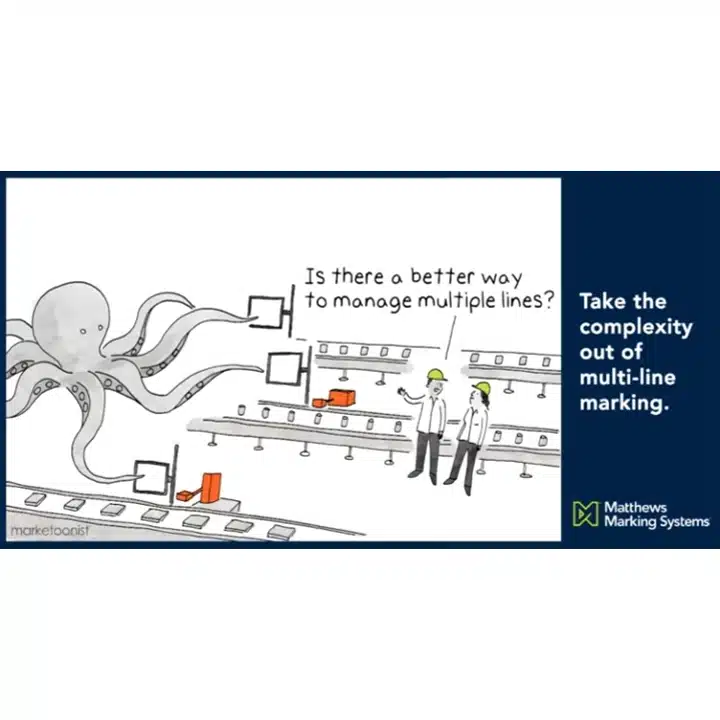
Ever feel like managing multiple production lines requires eight arms?
One screen for this printer. Another controller for that line. A different interface for case coding. Manual updates across systems. Operators walking back and forth to confirm changes.
Efficient? Debatable.
An octopus running multiple lines in a production facility may be an exaggeration. But for many operations, that image might feel uncomfortably familiar. When each line runs independently, complexity grows fast. And complexity has a cost.
The Reality of Multi-Line Marking
As production expands, marking environments rarely stay simple. Plants add:
• More SKUs
• More packaging variations
• New compliance requirements
• 2D codes alongside traditional formats
• Multiple marking technologies across lines
Over time, what started as one or two printers becomes a network of systems operating in parallel, but not always in sync.
Each line may have:
- Its own controller
- Its own job files
- Its own changeover process
- Its own opportunity for error
Managing updates across multiple lines often means repeating the same task multiple times. Every manual touchpoint increases the risk of inconsistencies. And when something goes wrong, troubleshooting becomes reactive instead of proactive. What starts as growth can quickly turn into coordination overhead.
Where Complexity Creeps In
Multi-line environments introduce friction in subtle ways:
Inconsistent file management
A code updated on one line doesn’t always get updated everywhere.
Operator dependency
Processes rely heavily on individual experience rather than standardized workflows.
Longer changeovers
Switching SKUs across several lines can require multiple system adjustments.
Limited visibility
Supervisors may not have a centralized view of what’s running, what’s queued, or what needs attention.
Over time, the system becomes harder to scale. Adding another line means adding another layer of coordination. That’s when an extra set of arms might come in handy.
A Different Approach to Multi-Line Management
But what if managing multiple lines didn’t mean managing multiple systems?
MPERIA® was designed to centralize control across marking technologies and production lines. Instead of operating independently, printers connect through a unified interface.
That means:
- Managing multiple printers from a single system
- Standardizing job creation and file control
- Reducing repetitive manual updates
- Supporting consistent workflows across lines
Rather than coordinating separate arms to keep everything moving, operations gain a coordinated control structure. The goal isn’t just to run more lines. It’s to run them with less friction.

Why This Matters Now
Production environments are becoming more complex, not less.
- 2D codes are increasing.
- Traceability requirements are expanding.
- SKU counts continue to grow.
- Changeovers need to happen faster.
In that environment, decentralized marking control becomes harder to sustain. What worked at two lines often doesn’t scale to five or ten without introducing risk.
Centralized management reduces risk. It supports consistency across technologies, improves control during changeovers, and helps operations scale without multiplying complexity.
Taking the Complexity Out of Multi-Line Marking
The cartoon is lighthearted. The challenge it represents is not. When production depends on multiple lines working in coordination, marking systems need to do the same.
MPERIA® brings that coordination under one structure reducing manual intervention, improving consistency, and helping operations, so no one needs to grow extra limbs to keep up.