


Six Signs It’s Time to Upgrade your Marking System
If your coders and labelers “still work… most days,” this one’s for you. Aging marking systems have a way of blending into the background, right up until they become the reason a line goes down, a shipment gets rejected, or a recall gets messy. At Matthews Marking Systems, we spend a lot of time inside plants diagnosing these headaches and helping teams modernize with less risk and more payoff. Our goal is simple: make marking clear, compliant, and effortless so you can run with confidence.

Below are six practical signs your equipment may be past its prime, plus what an upgrade can unlock.
1) You’re losing time (and sleep) to unplanned stops
Sign to watch: Frequent faults, clogging or constant “babysitting” to keep codes legible.
Why it matters: Every unplanned stop cascades, idle operators, starved or backed up conveyors, late pallets, missed trucks. Downtime from temperamental coders is one of the most expensive “hidden” costs in packaging.
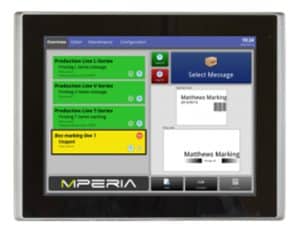
What an upgrade changes: Modern, industrial systems pair robust print technology with centralized control so you can prevent issues and recover faster when they happen. A universal controller like MPERIA® lets you monitor status, push fixes, and standardize best practices across lines, without running to each device.
2) Codes are readable… until they aren’t
Sign to watch: Fading dates, smeared barcodes, or 2D symbols that don’t always scan, especially after packaging changes or substrate swaps.
Why it matters: Retailers and regulators don’t grade on a curve. Unreadable or incorrect codes risk holds, rework, or penalties and undermine your brand’s hard earned trust.
What an upgrade changes: Newer platforms make consistent, scannable marks the default by combining high resolution print, recipe driven job control, and integrated verification. Many teams add code validation and approval workflows right in the print ecosystem, so the correct data prints, and proves it, every time.
3) Changeovers feel like defusing a bomb
Sign to watch: Operators rekey data by hand, track lot codes on sticky notes, or jog between HMI screens during changeovers.
Why it matters: Manual entry invites typos, slows restarts, and spikes stress, especially across multiple short runs or frequent promotions.
What an upgrade changes: Centralized, data driven control can pull the right fields from your ERP/MES (or a simple CSV), lock critical templates, and distribute approved jobs to every device, inkjet, laser, or labeler, from one interface. That means faster, safer changeovers and fewer “fat finger” mistakes.
4) You’ve outgrown a single line or a single plant
Sign to watch: You’re adding SKUs, new packaging, or another line, and your current setup doesn’t scale without a tangle of controllers, cables, and one off workarounds.
Why it matters: Growth shouldn’t force you to reinvent your marking each time. If scale introduces complexity, complexity introduces risk.
What an upgrade changes: A scalable architecture lets you start with one printhead and expand to multiple heads, multiple technologies, and multiple lines, often all managed from the same control layer. Teams standardize messages, audits, and reporting everywhere so quality and compliance follow you as you grow.
5) Consumables, parts, and service are getting hard (or expensive) to source
Sign to watch: You’re relying on discontinued inks or legacy parts, service response is slow, “creative” fixes keep the fleet alive.
Why it matters: What looks frugal on paper can be costly in the plant, ink waste, over maintenance, and sporadic support add up quickly.
What an upgrade changes: Modern systems are engineered to reduce maintenance touch time and optimize consumable use, while standardizing spares across lines. Pairing that with a global service network and remote support reduces the scramble when something does go wrong. It also simplifies training for new operators.
6) Compliance and audit needs outpaced your software
Sign to watch: No audit trails for edits, no user level permissions, and no systematic proof a code printed as intended.
Why it matters: In regulated spaces (think pharma, beverage alcohol, medical, or high spec industrial), you need traceability, who changed what, when, and why, and you need it at your fingertips.
What an upgrade changes: Contemporary controllers and software bake in user roles, change logs, and electronic approvals. Many also integrate vision systems for “print and verify” workflows that store results for QA and customer audits. That means fewer spreadsheets and faster, cleaner responses when quality calls.
What “good” looks like going into 2026 (and beyond)
When customers ask us what to aim for, we point to three pillars:
1. Centralized, universal control
Bring inkjet, laser, and label printing under one roof so jobs, data, and rules are consistent everywhere. A platform like MPERIA® is designed precisely for this, coordinating devices, consolidating data, and simplifying life for both operators and engineers. With centralized universal control, you can work from any connected controller on the line and not just one controller on the line.
2. Right fit print technology for your application
Primary packaging? High-resolution Axian XIJ, thermal inkjet or laser can give you crisp, durable codes without slowing the line.
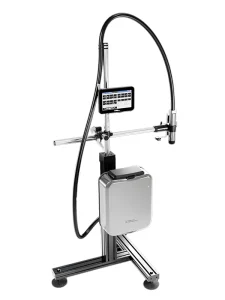
Secondary packaging? High-resolution piezo inkjet is a proven way to replace case labels with direct print.
Challenging industrial materials? Drop-on-demand valvejet thrives in dusty, tough environments. We help you match technology to substrate, speed, mark size, and durability requirements so you don’t over or underbuy.
3. Closed loop data and verification
From pulling master data to locking templates to verifying the code that actually hits the box, modern architectures close the loop. The goal isn’t just “print the mark,” it’s prove the mark and make it easy to scale that proof across products, lines, and plants.
Quick self assessment: Is it upgrade time?
- My marking systems are a top three cause of line downtime (or a frequent source of slow restarts).
- We’ve had retailer chargebacks or QA holds due to code issues in the last 12 months.
- Operators rekey data during changeovers instead of loading approved jobs with locked fields.
- We can’t see, from one screen, what’s printing where (and whether it’s good).
- Expanding to a new line or site feels like a ground-up rebuild of marking rather than plug-and-scale.
- Our software can’t show who changed what and when (or we’re piecing it together from emails and spreadsheets).
If two or more resonate, you’re likely leaving efficiency and peace of mind on the table.
The payoff you can expect from upgrading to modern marking systems.
- Less downtime, faster restarts: Fewer firefights, more steady throughput.
- Consistent, compliant codes: The right data, printed, validated, and documented.
- Faster, safer changeovers: Data driven jobs eliminate manual entry and reduce training burden.
- Simpler scale: One platform to manage many lines, technologies, and plants as you grow.
Ready to see what “modern” feels like?
If your current system is getting in the way of production, customers or audits, it’s time to explore a smarter path. We’ll help you mark with confidence, with an upgrade plan that fits your lines, your people, and your pace.