

Laser Marking: The Fastest-Growing Replacement for CIJ Technology
Whether you are exploring marking solutions for a brand new facility or a production line upgrade or expansion, there’s one option you can’t afford to overlook: laser marking technology. After all, you need every edge you can get in today’s highly competitive and rapidly evolving manufacturing landscape, and laser marking might be just the technology to keep you one step ahead.
Lasers are the fastest growing industrial marking technology in the market today. Fortune Business Insights reports that “the global laser marking machine market size was valued at USD 3.09 billion in 2023 and is projected to grow from USD 3.22 billion in 2024 to USD 6.01 billion by 2032, exhibiting a CAGR of 8.1% during the forecast period.”
Why Laser?
This innovative marking approach offers exceptional accuracy, durability, sustainability and versatility, making it an attractive option for manufacturers across a variety of industries. But laser marking has been around since the 1960’s, so why is it suddenly experiencing such high growth?
Let’s shed some light on the subject by first breaking it down.
Laser vs. Traditional: A Marked Difference
Laser marking technology harnesses the power of focused light to create permanent, high-precision marks (including text, logos, barcodes, or serial numbers) on a wide range of materials. The basic principle behind laser marking involves the interaction between the laser beam and the material’s surface, which can result in various effects depending on the material and the laser parameters used.
Here’s how laser marking stacks up against traditional marking methods:
Precision and Detail:
- Laser: Offers extremely high precision, capable of creating fine details and complex designs with ease. The process can be easily controlled and automated, allowing for repeatable and consistent results on small and intricate parts.
- Traditional: Techniques like stamping, engraving, or printing may struggle to achieve the same level of precision, especially on small or intricate parts.
Non-Contact Process:
- Laser: Laser marking is a non-contact process, which reduces wear and tear on both the marking tool and the product. This is especially useful for delicate or sensitive materials.
- Traditional: Other methods – such as stamping, engraving and stenciling – involve direct contact, potentially causing damage or degradation over time.
Material Versatility:
- Laser: Can mark a vast array of materials, from metals and plastics to glass , ceramics, and even some organic substances like wood or leather. Different types of lasers (e.g., fiber lasers, CO2 lasers) are suited to different materials.
- Traditional: Often require different tools or processes for different materials, limiting versatility.
Speed and Efficiency:
- Laser: Generally faster and more efficient, particularly in high-volume production environments. The process can also be integrated with automated systems for higher efficiency.
- Traditional: Often slower and may require more manual intervention, making them less suitable for high-speed or high-volume applications.
Durability and Environmental Impact:
- Laser: Produces marks that can withstand tough environments. Also typically requires no consumables (like ink or chemicals), making it an environmentally friendly option.
- Traditional: Marks may be less durable, and some methods involve consumables or chemicals that can have environmental implications.
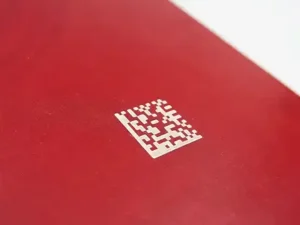
Laser Engraved 2D data matrix barcode on colored cardboard
Software: The Brains Behind the Beam
While the laser itself is impressive, it’s the software that truly unlocks the full potential of this technology and makes it attractive to modern manufacturers.
User-Friendly Interfaces:
- Intuitive design tools and customizable dashboards featuring drag-and-drop design tools, touchscreen interfaces, and more
- Reduced training time and improved accessibility
- Quicker setup and changeover between marking tasks for improved speed and flexibility
Easy Integration and Data Management:
- Real-time data exchange with other machinery, sensors, and ERP (enterprise resource planning) systems
- Improved uptime through proactive monitoring and maintenance
- Enhanced traceability and compliance management thanks to seamless integration with supply chain management and inventory systems
Advanced Automation:
- Streamlined workflow management through automated marking sequences, material detection, and batch processing
- Automated adjustments for consistent quality across materials
- Reduced manual intervention and human error, which speeds up production cycles
Vision System Integration:
- Real-time inspection and verification of mark quality
- Immediate defect identification and correction
- Reduced waste and associated costs
Scalability and Multi-Language Support:
- Easy scaling of marking operations across multiple production lines
- Consistent software platform for global operations
- Accommodation of regional language and regulatory requirements
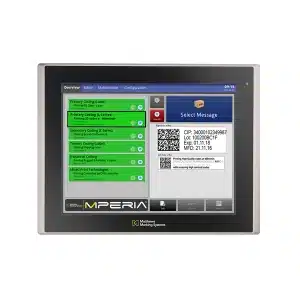
User-friendly MPERIA® software simplifies laser marking with custom design tools and real-time data integration.
The Bright Future of Marking
Laser marking technology, powered by sophisticated software, isn’t just another option in the industrial marking toolkit — it’s a transformative solution that demands consideration in any modern manufacturing environment. The rapid growth of the laser marking market underscores its increasing importance and potential impact on production processes.
Even if laser marking isn’t ultimately the chosen solution, a thorough assessment of its capabilities is imperative for making a fully informed decision.
Partnering with an industrial marking expert like the team at Matthews will provide invaluable guidance as you explore and evaluate all your options. Our highly experienced team can provide critical insights into both standard and custom-designed systems, ensuring you select the optimal marking solution for your unique production needs. By leveraging their expertise, you can confidently explore how laser marking — or other advanced technologies — will enhance your operations, improve product quality, and position your company for success in an increasingly competitive global market. A great place to start is with our MPERIA Lasers.
Don’t let your marking processes fall behind the curve. Embrace the future of industrial marking by giving laser technology the spotlight it deserves. Your products – and your bottom line – will thank you.
Want to learn more about integrating lasers into your production line? Read our blog post, Five Tips for Laser Marking Integration.