

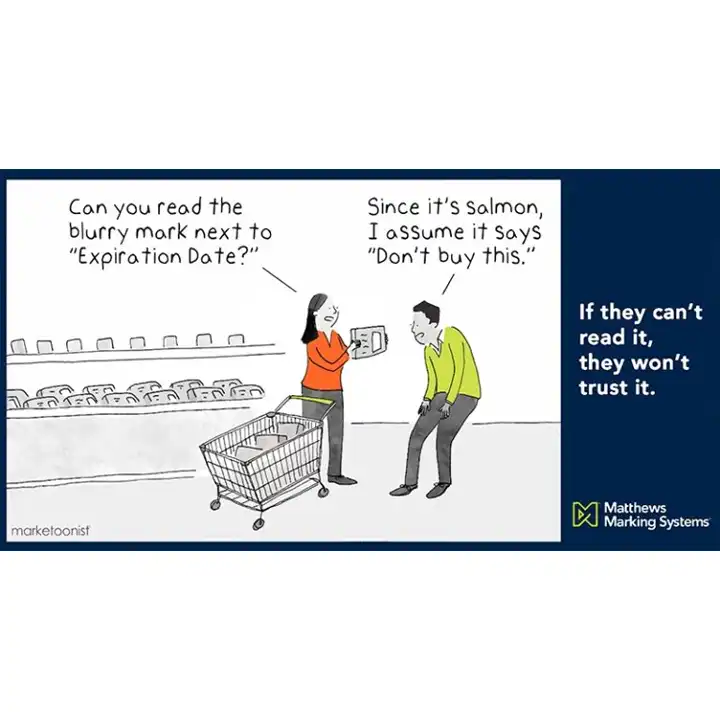
How Poor Code Quality Impacts Production, Traceability, and Customer Trust
You’re running full speed on a production line when it happens: the error rate on your product line skyrockets because of smudged lot codes, causing expensive rework and lost time. Or worse, your customers reject entire pallets of untraceable product because the barcodes won’t scan. It’s not just frustrating. It’s expensive. And preventable.
We’ve seen it too often. Companies unknowingly lose trust, money, and even customers just because their printed codes aren’t legible. It’s a silent killer of quality, and it’s time to bring it into the spotlight.
Let’s break down why poor code quality is more than a cosmetic problem, and how you can fix it before it costs you your reputation.
The Hidden Costs of Bad Codes
Unreadable or inconsistent codes can create ripple effects across your operation and beyond:
- Quality control failures: Fuzzy or smudged date and lot codes can lead to failed audits or forced product holds.
- Regulatory compliance risk: Many industries (like food, beverage, and pharma) require legible, traceable codes by law.
- Supply chain breakdowns: Barcodes that won’t scan mean delays, relabeling, or rejections, especially at distribution centers and warehouses.
- Brand damage: Customers see unreadable codes as sloppy. If your packaging looks careless, they’ll assume your product is too.
- Low efficiency scores: Downtime from manual reprints, scanning errors, or code verification bottlenecks can drag down OEE (Overall Equipment Effectiveness) and lead to missed KPIs.
According to GS1, over 60% of companies rank traceability and product data accuracy as mission critical. If your marking can’t be read by the human eye, or by a scanner, you’re compromising both.
Why This Happens More Than You Think
Many manufacturers assume their codes are good enough. But “good enough” doesn’t cut it in a market that demands speed, traceability, and compliance.
Here are some common causes of poor marking:
- Outdated equipment that doesn’t keep up with speed or environmental conditions.
- Incompatible inks and substrates leading to low contrast or smudging
- Manual message entry errors, especially without easy operation and control Lack of integrated code verification systems to catch bad codes before they ship
One of the most overlooked culprits? Old marking systems that haven’t been re-evaluated in years.
What a “Trustworthy” Code Looks Like
Great code quality isn’t just about appearance, it’s about function. Here’s what you should expect:
- Crisp, high-contrast text or barcodes that print clearly and dry instantly.
- First-time scan reliability across different surfaces and lighting conditions.
- Consistent placement and formatting, whether printing on product, case, or pallet.
- Compliance with GS1 standards, customer labeling requirements, and internal QA guidelines.
The bottom line: if a person or scanner can’t read it, the code doesn’t count.
How to Get It Right and Stay Ahead
The good news is that there’s a clear path to better, more reliable and higher quality codes. It starts with asking the right questions:
1. Are your current printers capable of keeping up with your production speed and materials?
2. Do your inks match the substrates you’re using today, not just last year or last decade?
3. Is your message management centralized and intuitive, or dependent on local operators making manual or complicated changes?
4. Do you have quality checks in place to catch marking issues before the product ships?
If the answer to any of these is “I’m not sure,” it’s time to take a closer look.
Today’s advanced marking systems are designed to eliminate these headaches. Features like automated message control, ink optimization, and even code validation systems can help you catch issues early and print with confidence every time.
Trust Starts at the Marking Stage
It’s easy to overlook printed codes until they’re the reason you lose traceability, miss a shipment, or damage your brand reputation.
Unreadable codes send the wrong message about your product, your process, and your professionalism. Don’t wait for a failed audit or angry customer to realize you have a problem.
Because if your customers can’t read it… they won’t trust it.
Would you like help auditing your current marking system or upgrading to a smarter, more consistent solution? Contact our experts to learn how Matthews Marking Systems can help.