


Reducing Marking Errors Through Automation: A Strategic Path to Improved Efficiency
Even small errors in product marking and coding can have serious consequences. From delays and rework to fines and damaged customer relationships, the ripple effect of these mistakes impact the bottom line and the brand’s reputation. As companies strive to improve Overall Equipment Effectiveness (OEE) and remain competitive, automation has become a powerful solution to eliminate marking errors, streamline operations, and boost productivity.
The Costs Add Up
Marking errors may seem like small issues, but their impact can be far-reaching. When products are mislabeled, entire production runs can be delayed or halted, leading to expensive rework and scrapping of materials. There are other financial losses resulting from operational inefficiencies. Incorrectly marked products need to be identified, sorted, and relabeled, taking valuable time away from core production tasks.
In some industries, marking errors also carry the risk of regulatory fines or retailer penalties, especially when incorrect product information affects shipping, traceability, or product safety. For companies that rely on precise coding and labeling to meet retailer or customer expectations, even minor errors can erode trust and tarnish a brand’s credibility. The cumulative effect of these issues often leads manufacturers to seek solutions that minimize human error and streamline the marking process.
Common Causes
Marking errors typically result from several common factors:
1. Multiple Controllers for Different Equipment
When production lines
use different machines with separate controllers, workers must manually operate each controller on the line and input data into each controller. This causes significant labor inefficiencies and increases the risk of data entry mistakes or inconsistencies.
2. Stand-Alone Equipment
In some production environments, marking machines operate as stand-alone units, disconnected from the larger system. This requires operators to manually update product data on each machine, making it easier for errors to occur, especially during product changeovers.
3. Non-User-Friendly Interfaces
Complicated or outdated machine interfaces can confuse operators, leading to incorrect entries. When interfaces are not intuitive, it becomes harder to maintain consistent, error-free operation.
4. Lack of Standard Operating Procedures (SOPs) and Training
Without documented processes and regular training, operators are more likely to make mistakes, particularly when managing multiple machines or systems.
How Automation Can Help
Automation directly addresses the root causes of marking errors by streamlining control, improving accuracy, and integrating data flow across production lines. Advanced automation systems offer several key benefits:
1. Integrated Systems and Controllers
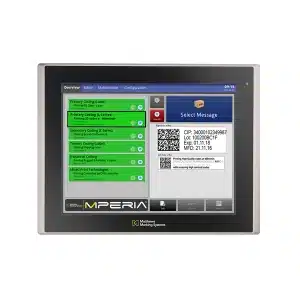
By centralizing control through a platform like MPERIA® from Matthews Marking Systems, manufacturers can manage all marking equipment from a single interface. This eliminates the need for manual data entry across multiple machines and production lines, reducing the likelihood of errors. Automated systems can also ensure that all machines are synchronized, so product codes, batch numbers, and labels are updated correctly and consistently.
2. Automated Product Changeovers
Automation enables seamless product transitions without the need for manual adjustments. For example, when production switches from one product line to another, the system can automatically update all relevant marking information across production lines, minimizing the risk of human error.
3. User-Friendly Interfaces
Modern automation platforms are designed with simplicity in mind, allowing operators to input and monitor data with ease. User-friendly systems reduce the complexity of marking operations, making it easier for operators to stay error-free, even during busy production periods.
4. Data-Driven Insights and Quality Control
Automation systems often include real-time monitoring and quality control features that allow operators to catch errors before they escalate. By tracking production data and marking accuracy, manufacturers can identify potential issues early and adjust accordingly to prevent larger problems down the line.
Case Study: Miller Chemical Scales Production with Automated Marking
Miller Chemical, a leading fertilizer manufacturer, was facing production slowdowns tied to manual labeling and inconsistent mark quality. As demand increased, so did the pressure to maintain accuracy without adding labor or creating bottlenecks on the line.
To solve this, Miller partnered with Matthews to implement a fully automated marking system built around the MPERIA® platform. The setup centralized control across multiple printers, allowing operators to manage messages and production changes from a single interface.
The solution included:
- L-Series Thermal Inkjet Printers: Delivering high-resolution, consistent codes directly on packaging at line speed
- MPERIA® Platform: Centralizing message control to reduce manual input and minimize operator error
- Integrated Conveyor System: Supporting continuous production with minimal disruption
With automation in place, Miller Chemical was able to reduce manual touchpoints, improve mark consistency, and keep production moving without added complexity.
Results
After implementing automated marking, Miller Chemical saw measurable improvements:
- Increased Throughput: Faster production with fewer interruptions from labeling errors
- Improved Accuracy: Centralized control reduced inconsistencies and rework
- Reduced Labor Dependence: Less manual handling freed up operators for higher-value tasks
- More Reliable Operation: Fewer stoppages tied to marking issues kept lines running
Final Thoughts
Miller Chemical’s transition to automated marking shows what happens when control and consistency are built into the process. By reducing manual input and centralizing operations, manufacturers can minimize errors while keeping production efficient and scalable.
Best Practices
For manufacturers considering automation, there are several best practices to follow:
1. Invest in Training and Documentation
Ensure that operators are trained on the new systems, and that SOPs are in place to guide consistent operations.
2. Choose User-Friendly Equipment
Select equipment that is intuitive and easy to use, minimizing the risk of errors during data input or machine setup.
3. Standardize Equipment and Processes
Integrate all marking and labeling equipment into a single system to ensure consistency across production lines.
4. Leverage Data for Continuous Improvement
Use real-time monitoring and data insights to identify potential issues and make proactive adjustments.
For more insights on integrating marking and coding, check out our MPERIA Controller page