

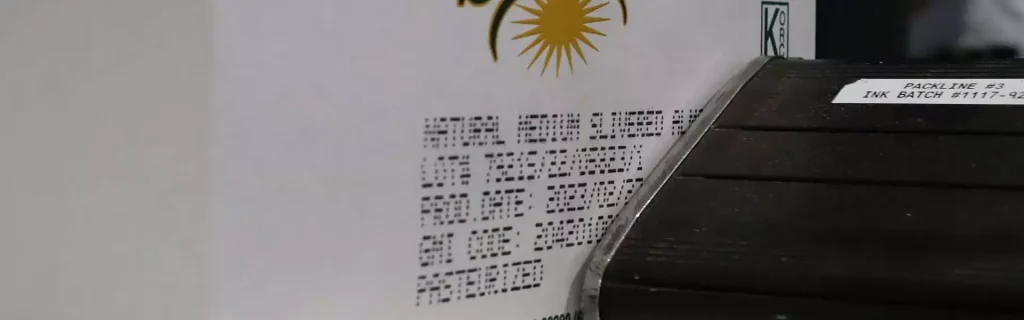
What makes valvejet printers the reliability champions?
For marking applications involving harsh conditions, valvejet excels where all other inkjet technologies falter. Why? Let’s take a look.
Marking industrial products – everything from metal pipes to large stacks of lumber– with codes and brand marks has been a necessity for decades. Before the advent of digital inkjet print technologies, marks were applied by physically stenciling products with rollers or engraving devices. We’re talking slow, messy and inflexible.
That all changed with the invention of inkjet printers in the late 1970s that could create whatever mark you wanted at high speed. Continuous inkjet (CIJ) and drop-on-demand (DOD) inkjet printers could both precisely place marks at the click of a button, but only one inkjet printer technology was up to the task for the most demanding industrial applications.
Valvejet technology wins when the going gets tough
While CIJ technology found broad acceptance for creating the small date codes found on consumer-packaged goods like bottles and cans, it has struggled to gain much traction in the industrial segment. CIJ printers are susceptible to failure due to contamination or temperature extremes, and can only create small characters, limiting their usefulness for many industrial applications that require large marks. Sierra Aluminum, for example, found that CIJ printers required extensive maintenance under the harsh conditions in the company’s plant that drove up costs resulting from downtime.
Valvejet printer technology, on the other hand, has proven to be the perfect fit for harsh industrial marking and coding applications, and continues to this day to be the runaway leader in virtually all industrial segments. The past 20+ years have seen the emergence of other DOD-style technologies such as thermal inkjet (TIJ) and piezo inkjet (PIJ) that are suitable for many marking applications such as carton/case coding. Yet, for most industrial applications, there’s simply no better or more reliable choice than valvejet – and that’s likely to be the case for the foreseeable future.
The reasons for valvejet print technology’s success for industrial (and other marking applications) are numerous:
- Outstanding reliability, supporting many years of operation with little to no maintenance.
- Able to withstand harsh environments, including dust and extreme temperatures.
- One of the most economical methods of printing available today with the ability to precisely tune ink consumption to match requirements.
- Versatility to make a wide range of marks, from less than ¼” to several feet high by stitching printheads together.
- Adaptable to production requirements, not the other way around. Valvejet printheads can be mounted over, under or beside a production line. They can also be mounted on robotic arms.
- Long throw distances (the distance between the printhead and the item to be marked) to accommodate uneven or bumpy production lines.
- Support for a broad range of porous and non-porous substrates and ability to work flawlessly with virtually any type of industrial grade ink. After decades of development, valvejet printers benefit from an unmatched — and still expanding — catalog of inks.
- More than enough speed to handle fast-moving production lines.
- Bulk ink supply systems that boost usability and help meet production runtime needs.
- Simple cleaning with automated built-in valve flushing systems.Valvejet printers propel ink droplets through precisely engineered nozzles onto the substrate.
Each droplet is controlled by a valve that opens briefly to release ink, then closes, which is why the technology is called drop on demand. Ink is delivered through a pressurized system that maintains a constant flow without waste. This design makes valvejet printers highly efficient and reduces the exposure of solvents and other ink chemicals to the surrounding environment. In contrast, CIJ printers use a continuous ink stream, where only select droplets are redirected to form marks. This process exposes more ink to the environment throughout operation.Compared to other DOD technologies including TIJ and Piezo, valvejet printers generally support higher line speeds, longer throw distances, overall lower cost of ownership, and greater durability under harsh conditions. Where TIJ and PIJ stand out is for applications that require higher-resolution marks, such as logos or very small barcodes.
Over 9 billion firings – Valvejet printers are built for reliable, low-maintenance, 24/7 operation in demanding industrial environments. They mark both porous and non-porous substrates with high-quality, long-lasting codes. Matthews V-Series DOD inkjet printers, for example, are rated for up to 9 billion firings before maintenance. In practice, many production sites report consistent, high-quality marks well beyond that point before any tuning is needed.Inside a 16-valve V-Series printhead, the valve itself plays a critical role. Drop on demand technology was first developed in Sweden in the late 1970s by Swedot AB, now part of Matthews Marking Systems. Since then, it has been refined over decades to improve durability and print quality.
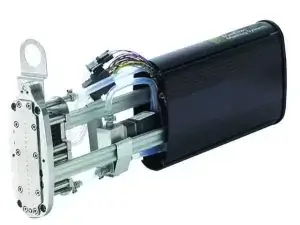
Looking inside a 16-valve V-Series printhead.
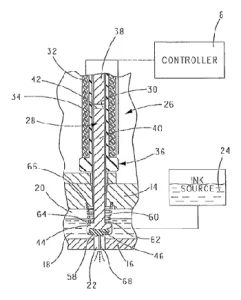
Each valve operates using a simple but precise mechanism. A plunger with a rubber tip seals the nozzle and is held in place by a spring. A solenoid coil pulls the plunger back just enough to release a controlled ink droplet through the nozzle and onto the substrate. The plunger distance is factory tuned to ensure consistent droplet size and print quality.
Patented design, continuous innovation
The specific design for the Matthews V-Series printheads, as shown below, is protected by United States patent US 9,108,424 BS titled Valve Jet Printer with Inert Plunger tip. This patent outlines key improvements to the plunger design that allows for the use of any ink type and ensures the plunger and rubber tip perform reliably over billions of cycles. Among the innovations are an improved plunger and seal design that is not available elsewhere across the industry.
It’s also important to note that valvejet printers achieve the greatest reliability when they are part of a complete system, including a fully integrated print controller, application-specific ink supply systems, and the right type of ink for the application. Ink variables that need to be accurately tuned include viscosity, drying time, and surface tension.
Valvejet technology has slightly larger dot sizes than other inkjet technologies, adding to the reliability equation. These larger drops are better able to absorb small dust particles or debris that may accumulate in front of the nozzles (remember these printers are often used in dust-filled conditions like sawmills or cement factories) and remove it from the printhead. As a result, the “line of fire” remains clear from build-up that otherwise would clog most printheads.